
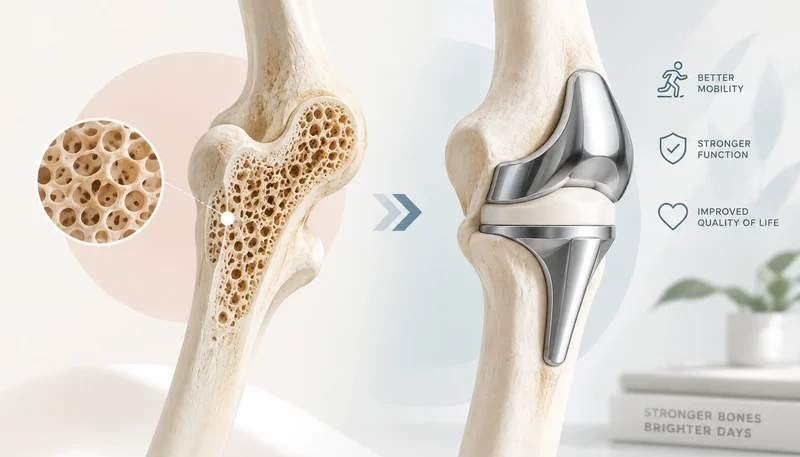

Patients in Uttam Nagar often ask a version of the same question when they’re dealing with both weak bones and joint pain: since a joint replacement is major surgery anyway, does it also fix the underlying osteoporosis? It’s a fair question with a clear, evidence-based answer, and understanding it properly changes how you should approach both conditions.
No, arthroplasty (joint replacement) does not treat osteoporosis. Osteoporosis is a whole-body bone density condition managed through medication, calcium, vitamin D, and lifestyle changes, not surgery. The two conditions are still closely connected: osteoporotic fractures sometimes require arthroplasty as treatment from an orthopaedic surgeon in Delhi; osteoporosis raises surgical risk during joint replacement, and bone density needs continued attention after the operation too.
Osteoporosis and Arthroplasty: Two Separate Conditions
Understanding these as different problems, even though they often appear in the same patient, is the starting point.
| Aspect | Osteoporosis | Arthroplasty |
| What it is | A whole-body bone density disease | A surgical joint replacement procedure |
| What it treats | Weak, fragile bone throughout the skeleton | Damage to a specific joint surface |
| How it is managed | Medication, calcium, vitamin D, lifestyle | Surgery to replace the damaged joint |
How the Two Conditions Actually Connect
A Hip Fracture Can Lead Straight to Arthroplasty
When osteoporosis causes a hip fracture, a genuinely common and serious complication, arthroplasty is often the direct treatment for that fracture, either a partial or total hip replacement depending on severity. This is surgery treating the break, not the bone disease that caused it.
Osteoporosis Raises Real Surgical Risk
Roughly two out of three patients undergoing joint replacement have some degree of osteoporosis or osteopenia, yet a large majority aren’t being actively treated for it at the time of surgery. Weak bone complicates implant fixation and raises the risk of a periprosthetic fracture, a break around the implant itself, a complication linked to notably worse recovery outcomes.
Surgery Can Further Affect Local Bone Density
The bone directly around a new implant can lose density over time through stress shielding, where the implant carries more of the mechanical load than the surrounding bone is used to. Bone health monitoring is therefore relevant well beyond the surgery date itself.
Cost of Arthroplasty Surgery
Actual cost depends heavily on implant type, fixation method, and individual case complexity, so the figures below are a general guide, not a fixed quote.
| Procedure | Typical Cost Range in Delhi NCR |
| Total knee replacement (per knee) | Approximately ₹1.5 lakh to ₹4.5 lakh |
| Total hip replacement (per hip) | Approximately ₹2.5 lakh to ₹7 lakh |
A personalised evaluation remains the only way to get an accurate figure for your specific case, particularly if additional bone health optimisation is needed beforehand.
Preparing for Arthroplasty When Osteoporosis Is a Factor
- A DEXA bone density scan before elective surgery, particularly for older patients or anyone with known risk factors
- Correcting vitamin D and calcium deficiencies in advance, rather than addressing them only after surgery
- A surgeon’s assessment of cemented versus cementless implant fixation based on your actual bone quality
- Continuing or starting appropriate osteoporosis treatment, coordinated between your physician and orthopaedic surgeon
Protecting Bone Density After the Operation
Bisphosphonates, a standard class of osteoporosis medication, have been shown to reduce both bone density loss around a new implant and overall revision surgery rates. This is a practical reason to stay engaged with bone health management well past the recovery period, rather than considering the joint “fixed” and the bone question closed.
Arthroplasty Options in West Delhi
Knee arthroplasty ranges from partial to total knee replacement, chosen based on how much of the joint is damaged. Hip arthroplasty spans resurfacing procedures to full total hip replacement, with the approach shaped by the pattern of damage, age, and bone quality together. The fixation method, cemented, cementless, or hybrid, is matched to each patient’s individual bone density rather than applied uniformly.
When to Consult an Orthopaedic Specialist in Uttam Nagar
You should consult an orthopaedic specialist in Delhi if you have persistent joint pain unresponsive to conservative treatment, a known osteoporosis diagnosis alongside joint symptoms, or a recent fragility fracture. Evaluating your joint and your bone density together gives a genuinely more complete picture than treating either in isolation.
Conclusion
Arthroplasty and osteoporosis are connected, but not in the way the question usually implies. Joint replacement doesn’t treat osteoporosis, and osteoporosis isn’t resolved by getting a new joint. What matters is recognising how they genuinely interact: osteoporotic fractures sometimes need arthroplasty to repair, osteoporosis shapes surgical planning and risk, and bone protection remains relevant long after surgery. Gandhi Hospital’s orthopaedic team in Uttam Nagar offers a combined evaluation that treats both concerns seriously.
Gandhi Hospital has served West Delhi families for more than three decades from its Om Vihar location in Uttam Nagar, growing from a one-room clinic founded by Dr Pawan Gandhi in 1989 into a 60-bed multispeciality hospital with a dedicated Orthopaedics department. With OPD, IPD, ICU, emergency, and diagnostic services under one roof, Gandhi Hospital offers accessible, experienced orthopaedic evaluation for joint replacement in Uttam Nagar without the need to travel further into the city. Learn more or book a consultation at gandhihospital.info.
Frequently Asked Questions
Yes, osteoporosis doesn’t rule out arthroplasty, but it does mean your surgeon will plan the fixation approach and any pre-surgery bone health steps around your specific bone density.
It’s increasingly recommended for older patients or those with known risk factors, so it’s worth asking your surgeon directly whether a DEXA scan applies to your situation.
Not necessarily, but unmanaged osteoporosis does raise the risk of certain complications, which is exactly why continued bone health management after surgery matters.
Both can be affected, since fixation and long-term stability depend on bone quality in either joint, though the specific surgical approach may differ based on which joint and how severe the bone loss is.
This should be confirmed with both your physician and orthopaedic surgeon together, since some medications are continued through surgery while timing around others may need coordination.