
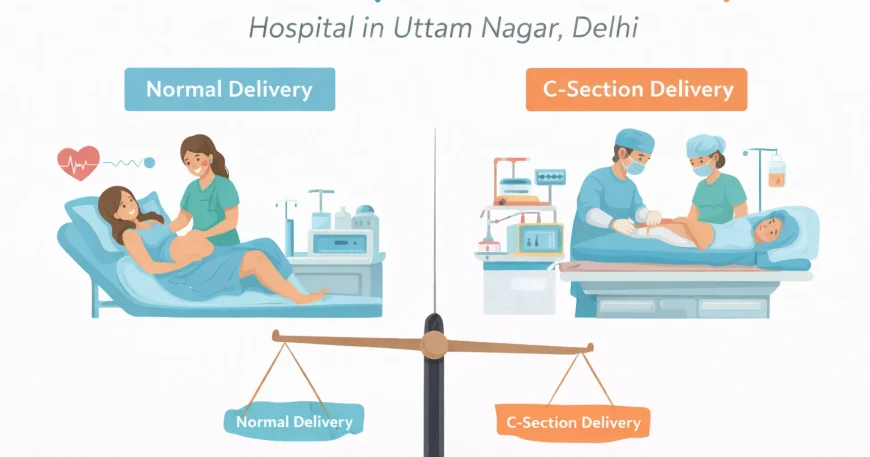

In India, 21.5% of institutional births occur through C-section, according to NFHS-5 (2019–21), while the World Health Organization recommends 10–15% as the optimal population rate (WHO-RHR-15.02; NFHS-5). In Delhi, the C-section rate stands at 23.6%, with 42.8% in private hospitals and 17.7% in public hospitals (NFHS-5). In Delhi, 91.8% of births take place in medical institutions, which means delivery method decisions primarily occur within hospital settings (NFHS-5). This makes the comparison between normal delivery and C-section delivery a hospital-based decision rather than a home-based one.
Normal delivery involves vaginal birth through three clinical stages of labor. C-section delivery involves abdominal surgery performed under spinal or regional anesthesia. Doctors recommend C-section when medical risk factors appear, including fetal distress, placenta previa, or previous uterine surgery. This article compares normal delivery and C-section delivery using Delhi-specific data, national benchmarks, measurable recovery timelines, hospital stay duration, cost ranges, and maternal risk indicators.
India and Delhi C-Section Rate Statistics
In India, 21.5% of institutional births occur through C-section, according to NFHS-5 (2019–21). The World Health Organization recommends 10–15% as the population-level benchmark for C-section rates (WHO-RHR-15.02). Rates above 10% show no additional reduction in maternal or newborn mortality at the population level.
In Delhi, the C-section rate is 23.6%, which exceeds the WHO benchmark. Urban Delhi reports 23.4%, while rural Delhi reports 28.2% (NFHS-5). This indicates higher surgical delivery prevalence compared to the recommended threshold. In Delhi private hospitals, 42.8% of births occur via C-section. In Delhi public hospitals, the rate is 17.7% (NFHS-5). This shows a difference of 25.1 percentage points between private and public facilities.
In Delhi, 91.8% of births take place in medical institutions (NFHS-5). This high institutional delivery rate means most mothers choose between normal delivery and C-section within hospital settings.
Globally, approximately 20% of births occurred through C-section in 2023 (UNICEF). Delhi’s 23.6% rate aligns with urban global trends but exceeds WHO’s recommended benchmark.
C Section Surgery Procedure in Delhi Hospitals
A C-section is a surgical procedure that typically lasts 30 to 60 minutes from incision to closure. Doctors perform the surgery under spinal or regional anesthesia, which keeps the mother awake while blocking pain below the waist. The abdominal incision usually measures 10 to 15 centimeters and allows direct access to the uterus. After delivering the baby, surgeons close the uterus and abdominal wall in layers.
Planned C-sections are usually scheduled after 39 weeks of pregnancy unless medical risk requires earlier delivery. Emergency C-sections occur when fetal distress, stalled labor, or maternal complications develop during labor.
Hospital stay after a C-section typically ranges from 2 to 3 days, according to Mayo Clinic clinical guidance. Mothers usually begin assisted walking within 24 hours after surgery to reduce clot risk.
Postoperative monitoring in Delhi hospitals includes blood pressure checks, incision inspection, urine output monitoring, and neonatal assessment within the first 24 hours.
Spinal anesthesia typically provides pain relief for 2 to 4 hours after administration. Additional pain management continues through oral or injectable medication during hospital stay.
Medical Indications for C Section in Delhi
Doctors recommend C-section when medical risk crosses defined safety thresholds. The decision depends on maternal condition, fetal status, and labor progression. Fetal distress becomes an indication when abnormal heart rate patterns persist beyond 10 minutes despite corrective measures. Continuous electronic fetal monitoring in Delhi hospitals detects these changes in real time.
Placenta previa requires surgical delivery when the placenta covers the cervical opening by any measurable margin. Vaginal delivery in complete placenta previa carries high hemorrhage risk. Previous C-section increases uterine rupture risk, which occurs in approximately 0.5–1% of women attempting vaginal birth after one prior low-transverse incision. Doctors assess scar type before planning delivery mode. Multiple pregnancy increases operative delivery probability. Twin pregnancies show higher C-section rates compared to single pregnancies, especially when the first twin is not in head-down position.
Breech presentation at term affects approximately 3–4% of pregnancies. Many tertiary hospitals in Delhi recommend planned C-section for persistent breech at ≥37 weeks gestation. Labor arrest becomes a surgical indication when cervical dilation does not progress for 4 hours with adequate contractions. Obstetric guidelines define this as active phase arrest.
Severe maternal conditions such as preeclampsia with blood pressure ≥160/110 mmHg may require expedited delivery, including C-section if induction is unsafe.
Recovery Timeline: Normal Delivery vs C Section in Delhi
- After normal delivery, most mothers begin walking within 6 to 12 hours if stable. Hospital discharge usually occurs within 24 to 48 hours in uncomplicated cases.
- Vaginal tissue healing typically progresses over 2 to 3 weeks, while complete internal recovery may take up to 6 weeks. Doctors advise avoiding heavy lifting for at least 4 to 6 weeks.
- After C-section surgery, assisted walking usually begins within 24 hours to reduce clot formation risk. Hospital stay typically lasts 2 to 3 days.
- Surgical incision healing takes approximately 4 to 6 weeks. Doctors restrict lifting objects heavier than 4 to 5 kilograms during this period.
- Driving is generally avoided for about 2 weeks after C-section, depending on pain control and mobility. Return to routine physical activity often requires 6 to 8 weeks.
- Pain intensity remains higher during the first 3 to 5 days after C-section compared to vaginal birth. Oral pain medication continues during the initial recovery phase.
In Delhi hospitals, postpartum follow-up visits typically occur at 6 weeks after delivery for both delivery types.
Pain, Anesthesia and Hospital Stay Duration in Delhi
- Spinal anesthesia used in C-section provides pain relief for approximately 2 to 4 hours after administration. Additional analgesics are required during the first 24 to 72 hours post-surgery.
- Hospital stay after C-section typically ranges from 2 to 3 days. In contrast, hospital stay after normal delivery usually ranges from 24 to 48 hours.
- Postoperative pain peaks during the first 3 to 5 days after C-section. Vaginal delivery pain usually decreases significantly within 2 to 3 days, unless episiotomy or tears are present.
- Epidural anesthesia during normal labor can remain effective for several hours and may be adjusted throughout labor progression. It does not extend hospital stay beyond the typical 1 to 2 days for uncomplicated cases.
- Mothers are encouraged to begin mobilization within 6 to 12 hours after normal delivery and within 24 hours after C-section to reduce thrombosis risk.
In Delhi tertiary hospitals, postoperative monitoring during the first 24 hours includes blood pressure checks, bleeding assessment, and urine output tracking for both delivery types.
Cost Range: Normal Delivery vs C Section in Delhi Hospitals
In Delhi private hospitals, normal delivery typically ranges between ₹40,000 to ₹90,000, depending on room category and obstetrician fees. Government hospitals may provide normal delivery services at minimal or subsidized cost. C-section surgery in Delhi private hospitals typically ranges from ₹80,000 to ₹1,80,000, depending on hospital tier, surgeon charges, anesthesia fees, and length of stay.
NFHS-5 reports that 42.8% of births in Delhi private facilities occur through C-section compared to 17.7% in public facilities. Higher private-sector surgical rates influence overall cost exposure. Hospital stay adds 2 to 3 days of admission cost in C-section cases compared to 1 to 2 days for uncomplicated normal delivery.
NICU admission, if required, can significantly increase total expenditure. Institutional deliveries in Delhi account for 91.8% of births, which means most cost differences arise within hospital-based care structures.
Cost variation also depends on ICU availability, emergency OT access, and 24×7 obstetric coverage in tertiary centers.
Maternal and Neonatal Risk Comparison (India Data)
The World Health Organization recommends 10–15% as the optimal population C-section rate, and reports no additional mortality reduction beyond 10% at population level. India’s institutional C-section rate stands at 21.5%, exceeding this benchmark (WHO; NFHS-5).
In India, the Maternal Mortality Ratio (MMR) is approximately 97 per 100,000 live births (Sample Registration System). Surgical delivery increases operative exposure, including anesthesia-related and wound-related risks.
- Uterine rupture risk during vaginal birth after one previous low-transverse C-section occurs in approximately 0.5–1% of cases. This risk influences repeat surgical planning.
- Postoperative recovery after C-section typically requires 4 to 6 weeks for incision healing. Vaginal delivery recovery often stabilizes within 2 to 3 weeks, unless complications occur.
- Neonatal respiratory complications show higher incidence in elective C-sections performed before 39 weeks gestation. Planned surgical timing at ≥39 weeks reduces this risk.
Global data shows approximately 20% of births occur via C-section (UNICEF 2023). Delhi’s rate of 23.6% reflects higher surgical exposure compared to the WHO-recommended threshold.
In Delhi, the C-section rate stands at 23.6%, while 42.8% of private hospital births occur through C-section compared to 17.7% in public hospitals (NFHS-5). These differences influence hospital stay duration, cost exposure, and recovery timeline.
The table below compares measurable clinical and hospital factors relevant to Delhi-based institutional deliveries.
| Parameter | Normal Delivery | C Section Delivery |
| Procedure Type | Vaginal birth | Surgical abdominal procedure |
| Surgery Involved | No | Yes |
| Average Duration | Labor may last 6–12 hours (first stage) | Surgery lasts 30–60 minutes |
| Anesthesia | Optional epidural | Spinal/regional anesthesia mandatory |
| Hospital Stay | 24–48 hours | 2–3 days |
| Walking Begins | 6–12 hours | Within 24 hours |
| Recovery Period | 2–6 weeks | 4–8 weeks |
| Risk Exposure | Labor-related complications | Surgical + anesthesia risks |
| Delhi Private Hospital Cost | ₹40,000–₹90,000 | ₹80,000–₹1,80,000 |
| When Recommended | Low-risk pregnancy | Fetal distress, placenta previa, prior C-section, labor arrest |
Institutional delivery in Delhi accounts for 91.8% of births, which means these differences apply primarily within hospital-based care systems.
When Delhi Doctors Recommend Planned C Section
Doctors schedule planned C-section at ≥39 weeks of pregnancy in uncomplicated cases to reduce neonatal respiratory risk. Elective delivery before 39 weeks increases breathing complications. In Delhi, 23.6% of births occur via C-section, and 42.8% of private hospital births are surgical (NFHS-5). This reflects structured planning in high-risk pregnancies.
Previous C-section significantly increases repeat surgical probability. Uterine rupture risk during vaginal birth after one prior low-transverse incision ranges between 0.5–1%, which influences surgical planning.
- Placenta previa requires surgical delivery when placental tissue covers the cervical opening at term. Attempting vaginal birth in complete previa increases hemorrhage risk.
- Severe hypertension defined as blood pressure ≥160/110 mmHg may require expedited delivery. Doctors may choose C-section when induction poses maternal or fetal risk.
- Multiple pregnancy increases operative delivery rates, especially when the first twin is not head-down at ≥37 weeks gestation.
- Labor arrest becomes a surgical indication when cervical dilation does not progress for 4 hours despite adequate contractions.
Delhi tertiary hospitals with 24×7 obstetric coverage schedule planned C-sections when medical criteria are met rather than on non-medical preference.
Normal Delivery Hospital and C Section Surgery Hospital in Delhi
In Delhi, 91.8% of births occur in institutional settings (NFHS-5). Hospital infrastructure directly affects delivery safety and emergency response time.
- Verify whether the hospital provides 24×7 obstetrician availability. Continuous labor monitoring reduces delay during complications that may require surgical intervention within minutes.
- Confirm the presence of a functional operation theatre (OT) available at all hours. Emergency C-section may need to begin within 30 minutes of decision in fetal distress scenarios.
- Check if the hospital maintains a Level II or Level III NICU. Neonatal respiratory complications increase when delivery occurs before 39 weeks, and NICU access allows immediate respiratory support.
- Ensure on-site blood bank or blood storage unit availability. Postpartum hemorrhage remains a leading cause of maternal complications, and rapid transfusion capacity is critical.
- Evaluate ICU access for maternal monitoring when severe hypertension reaches ≥160/110 mmHg or when surgical complications occur.
- Compare Delhi private facility C-section rates (42.8%) with public facility rates (17.7%) to understand institutional practice patterns (NFHS-5).
Hospital selection should depend on risk profile, infrastructure readiness, and obstetric supervision rather than delivery preference alone.
Delhi-Focused FAQs
Is C-section safer than normal delivery in Delhi?
In Delhi, the C-section rate is 23.6%, which exceeds the WHO recommended 10–15% benchmark (NFHS-5; WHO). Safety depends on medical indication such as fetal distress, placenta previa, or prior uterine surgery rather than delivery preference.
How many days hospital stay after C-section in Delhi?
Hospital stay after C-section typically lasts 2–3 days, compared to 24–48 hours after uncomplicated normal delivery.
Is normal delivery cheaper than C-section in Delhi?
In Delhi private hospitals, normal delivery typically ranges between ₹40,000–₹90,000, while C-section ranges from ₹80,000–₹1,80,000, depending on facility tier and length of stay.
Can I choose elective C-section in Delhi hospitals?
Elective C-sections are usually scheduled at ≥39 weeks to reduce neonatal respiratory risk. Doctors assess maternal and fetal health before scheduling.
Can I attempt normal delivery after one C-section in Delhi?
Uterine rupture risk during vaginal birth after one prior low-transverse C-section ranges between 0.5–1%. Doctors evaluate scar type and hospital surgical readiness before planning.
Childbirth surgery and normal delivery at Gandhi Hospital, Uttam Nagar, Delhi
At Gandhi Hospital, Uttam Nagar, experienced obstetricians assess blood pressure levels, fetal position, previous uterine surgery, gestational age, and real-time monitoring findings before recommending the safest delivery method.
If you are between 36–38 weeks of pregnancy, schedule a detailed delivery planning consultation. Bring your ultrasound reports, medical history, and lab results to discuss whether normal delivery is suitable or if C-section is medically indicated. Gandhi Hospital provides 24×7 obstetric coverage, emergency OT access, and structured maternal monitoring to ensure timely and safe childbirth decisions.